
8 Project Management Methodologies to Choose From Today
There’s no universal playbook that fits every team, timeline, and objective. Project management methodologies provide structured blueprints—principles, practices, and workflows—that help teams plan, execute, and deliver work predictably. Choosing the right project management methodology can reduce risk, accelerate delivery, and improve stakeholder alignment. This guide explains eight commonly used methodologies, when to apply each, and practical steps to select the best fit for your project.
What are project management methodologies and why they matter
At their core, project management methodologies are organized approaches for turning ideas into delivered outcomes. They define how teams break work into tasks, allocate resources, track progress, and respond to change. The right methodology aligns to project complexity, uncertainty, team size, and stakeholder expectations.
Adopting and tailoring a methodology helps you:
- Clarify roles, responsibilities, and decision points
- Prioritize work and manage dependencies
- Improve visibility, communication, and accountability
- Mitigate risks through repeatable processes
What are the most common project management methodologies?
Below are eight methodologies regularly used across industries. For each, you’ll find a concise description, strengths, common use cases, and practical tips for implementation.
1. Agile
Agile is an iterative approach focused on customer collaboration, fast feedback cycles, and responsiveness to change. Rather than delivering all requirements at once, Agile breaks work into smaller increments that are continuously refined.
Strengths:
- High adaptability to evolving requirements
- Frequent feedback reduces rework
- Encourages cross-functional collaboration
Best for: Software development, product design, and projects where requirements are likely to change.
Implementation tips: Start with short iterations, prioritize a product backlog, and establish regular reviews to gather stakeholder feedback.
2. Scrum (an Agile framework)
Scrum is a popular Agile framework that organizes work into fixed-length iterations called sprints (commonly 2–4 weeks). Roles such as Product Owner and Scrum Master provide structure and accountability.
Strengths:
- Clear sprint goals and predictable delivery cadence
- Daily stand-ups promote team alignment
- Frequent retrospectives drive continuous improvement
Best for: Small, cross-functional product teams requiring rapid iteration and continuous stakeholder feedback.
Practical note: Make sure roles are defined, maintain a prioritized backlog, and hold consistent sprint ceremonies (planning, daily stand-up, review, retrospective).
3. Kanban
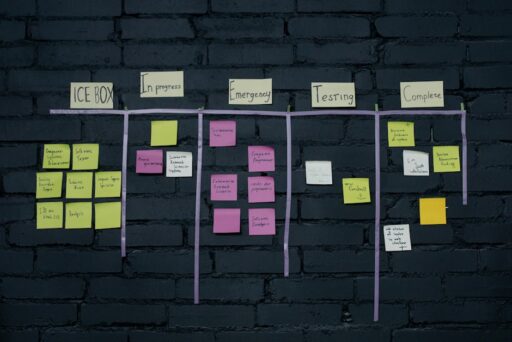
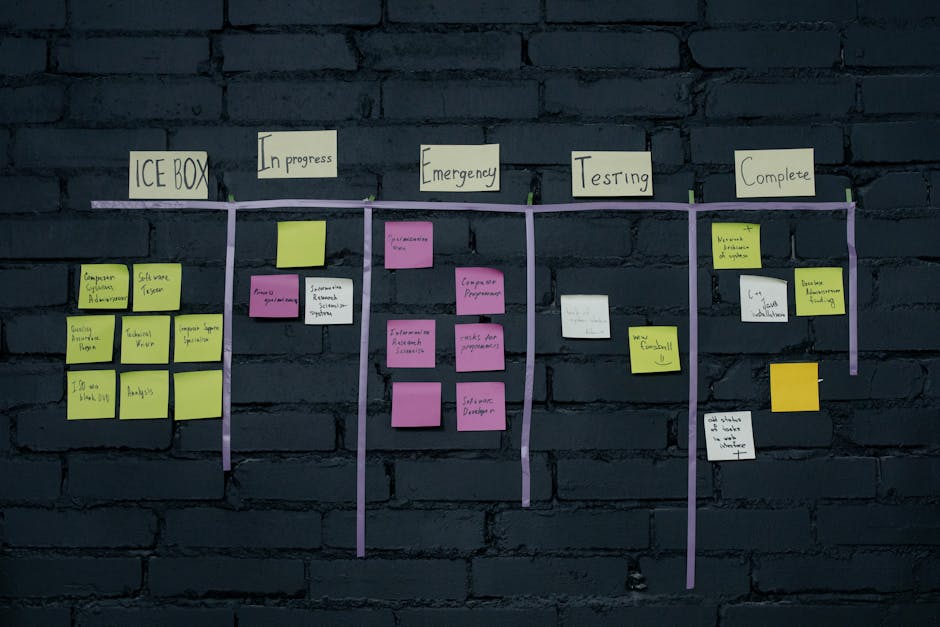
Kanban is a visual workflow system that limits work in progress to improve flow. Tasks move across a board (e.g., To Do, In Progress, Done), helping teams quickly spot bottlenecks.
Strengths:
- Lightweight and easy to adopt
- Continuous flow without prescribed iterations
- Excellent for balancing demand and team capacity
Best for: Operational teams, maintenance work, or environments that require flexible prioritization and continuous delivery.
Implementation tips: Visualize your workflow, set WIP limits, and review cycle times to identify improvement opportunities.
4. Waterfall
Waterfall is a linear, sequential methodology where each phase (requirements, design, implementation, testing, deployment) must complete before the next begins. It is plan-driven and emphasizes thorough documentation upfront.
Strengths:
- Clear timelines and defined deliverables for each phase
- Works well when requirements are fixed and well-understood
- Easier to estimate costs and resources early on
Best for: Construction, manufacturing, or projects with stable requirements and regulatory constraints.
Caveat: Waterfall can be inflexible if major changes emerge mid-project—factor contingency into your plan.
5. PRINCE2
PRINCE2 (PRojects IN Controlled Environments) is a process-driven methodology emphasizing governance, roles, and formal stage gates. It focuses on justification, controlled stages, and clear responsibilities.
Strengths:
- Strong governance and risk management
- Scales well for large, complex programs
- Clear structure for accountability and decision-making
Best for: Public-sector programs, large enterprises, or projects where formal controls and auditability are required.
Implementation tip: Define the project board and stage boundaries early, and use business justification documents to maintain alignment.
6. Critical Path Method (CPM) and CCPM
CPM identifies the longest sequence of dependent tasks that determine a project’s minimum completion time. CCPM (Critical Chain Project Management) extends CPM by focusing on resource constraints and protecting the schedule with buffers.
Strengths:
- Clear identification of dependencies and milestones
- Helps optimize schedules where tasks are interdependent
- CCPM improves resource utilization and reduces multitasking
Best for: Construction, engineering, and projects with strict sequencing and resource constraints.
Tip: Map dependencies early, compute the critical path, and add strategic buffers where uncertainty or resource contention exists.
7. PRiSM (Projects Integrating Sustainable Methods)
PRiSM emphasizes sustainability, environmental impact, and social responsibility across the project lifecycle. It integrates environmental management with traditional project controls.
Strengths:
- Focuses on long-term environmental and social outcomes
- Reduces lifecycle impacts and supports regulatory compliance
- Enhances corporate responsibility and stakeholder trust
Best for: Infrastructure, construction, and public-sector projects where sustainability and lifecycle impacts matter.
Implementation note: Embed sustainability criteria into your scope, procurement, and post-delivery evaluation processes.
8. Hybrid approaches
Many organizations combine methodologies—mixing Agile with Waterfall elements, or using Kanban within an Agile framework—to match organizational culture, regulatory constraints, and delivery needs. Hybrid models let you capitalize on the strengths of multiple approaches while mitigating weaknesses.
Strengths:
- Flexible and tailored to organizational realities
- Balances predictability and adaptability
- Supports phased adoption of new practices
Best for: Organizations undergoing transformation or projects that require both stability and speed.
How to choose the right project management methodology
Selecting the best approach starts with assessing project characteristics, team skills, and stakeholder expectations. Use this decision checklist:
- Define clarity of requirements: Are objectives fixed or likely to change?
- Gauge complexity: How many interdependent tasks and stakeholders exist?
- Evaluate delivery speed: Is rapid iteration more valuable than rigid planning?
- Consider governance needs: Are audits, compliance, or formal approvals required?
- Assess team maturity: Does the team have experience with iterative or plan-driven methods?
Match your answers to the methodologies above—Agile or Scrum for adaptive, customer-centric projects; Waterfall or PRINCE2 for regulated or fixed-scope initiatives; Kanban for continuous flow and operational work; CPM/CCPM for dependency-heavy schedules; PRiSM when sustainability is a core objective.
How do successful teams implement a new methodology?
Adopting a methodology requires planning, training, and incremental change management. Follow these practical steps:
- Run a pilot on a small, non-critical project to learn and adapt.
- Train key roles (e.g., Product Owner, Scrum Master, project leads) and document responsibilities.
- Define minimum viable ceremonies and artifacts to avoid over-burdening the team.
- Measure outcomes (velocity, cycle time, defect rate) and iterate on process improvements.
- Communicate changes across stakeholders and align expectations.
For guidance on improving team productivity alongside your methodology choice, see our guide on Boost Efficiency: The Ultimate Guide to Employee Productivity Tracking and practical tips for team alignment in How to Run Effective Meetings: Boost Team Productivity.
What pitfalls should you avoid when selecting a methodology?
Common mistakes include:
- Rigidly applying a single methodology without tailoring to the context
- Neglecting stakeholder engagement and change management
- Under-investing in role clarity and training
- Failing to measure and iterate on process performance
Instead, choose a pragmatic approach: pick core practices to start, measure outcomes, and evolve the process based on real-world feedback.
Practical comparison: When to pick each methodology (quick reference)
- Agile / Scrum: Product development with changing requirements and frequent feedback.
- Kanban: Continuous delivery, operational work, or support teams.
- Waterfall: Fixed-scope projects with well-defined requirements and compliance needs.
- PRINCE2: Large-scale, governance-heavy programs needing clear stage controls.
- CPM / CCPM: Projects with complex dependencies and constrained resources.
- PRiSM: Projects with strong sustainability and lifecycle impact concerns.
- Hybrid: When you need both predictability and agility.
Next steps: Evaluate, pilot, and scale
Start by assessing one or two pilot projects where the stakes are manageable. Track metrics that matter (delivery predictability, stakeholder satisfaction, quality) and use results to refine the approach. As you scale, codify your processes, train more teams, and maintain a feedback loop for continuous improvement.
If your team is working remotely or across time zones, consider how the chosen methodology handles asynchronous communication and distributed workflows—our posts on Mastering Remote Work: Essential Skills for Success and Maximizing Efficiency: Choosing the Right Time Tracking Software for Your Business offer complementary strategies for remote teams and operational efficiency.
Conclusion
No single methodology will be perfect for every scenario. The most effective organizations treat methodologies as tools—not dogma—and adapt them to the realities of their projects and teams. Whether you need speed and adaptability, strict governance, optimized scheduling, or sustainability-focused delivery, there’s a methodology (or combination) that will help you deliver better outcomes.
Ready to choose the right methodology for your next project?
Take our checklist, run a pilot, and measure results. If you need a structured assessment or coaching to select and implement the best approach, Tempus Tact offers tailored advisory services to help teams adopt and scale effective project practices. Contact us to evaluate your project landscape and build a roadmap for consistent delivery and continuous improvement.
Call to action: Request a free methodology assessment and get a customized plan for your team—start delivering smarter, faster, and with less risk.